Wednesday, January 1, 2020
To strive, to seek, to find, and not to yield. -ULYSSES by Alfred Lord T...
This poem by Lord Tennyson has been one of my mottoes and the inspiration since my college year. I thank my English professor for introducing us to this.
"...'Tis not to late... ... To strive, to seek, to find, and not to yield!"

Thursday, January 26, 2017
Beautiful Song from "Spirited Away"
"Itsumo Nando demo" (Whenever, and as many times) from "Spirited Away"
「千と千尋の神隠し」から ”いつも何度でも” ‐ 木村弓
I was able to watch the original Japanese version of "Spirited Away." I've watched it before in English.
It spoke to me deeply partially because it was in Japanese and also I have grown older.
I wanted to share with you my rough translation of this beautiful lyrics, and in doing so, I took the liberty.
The Lyre Ms. Kimura is playing here in the video is very familiar to the Steiner-Waldorf educators, and I have played it before as well.
"Itsumo Nando demo" (Whenever, and as many times)
Music and Vocal by Kimura Yumi
English Translation: Hikaru Miyakawa
"It's calling me from somewhere deep within my bosom(heart),
...wanting to dream the kind of dream where my heart can dance with joy and anticipation...
Though there are countless sadness, beyond it I'm certain that I can find you
Whenever the mistakes are repeated, one gets to realize the blueness of the simple, blue firmament...
Though the path before me may appear to continue forever, these hands can embrace the light.
The silent heart at the moment of its departure, listens intently through the body which is bound to become 'zero,'
...mystery of living,
...mystery of dying,
...(whether it is) the flower, the wind, the city streets - it applies to all
La, la, la...
It is calling from somewhere deep within (me)... (so) let us dream the dream whenever and as many (much) as we can...
Instead of counting and uttering away the sadness, (let us) sing gently with the same lips...
Within the subsiding memory I always hear the whisper that I do not wish to forget.
Even on the shattered pieces of mirror the new scenery is reflected.
In the commencing morning through the silent window,
may the body which is bound to become 'zero,' expand and be fulfilled...
I shall no longer look far beyond the boundary of the sea to find that which shines, for I was able to find it here... and it always have been ...within me"
「千と千尋の神隠し」から ”いつも何度でも” ‐ 木村弓
I was able to watch the original Japanese version of "Spirited Away." I've watched it before in English.
It spoke to me deeply partially because it was in Japanese and also I have grown older.
I wanted to share with you my rough translation of this beautiful lyrics, and in doing so, I took the liberty.
The Lyre Ms. Kimura is playing here in the video is very familiar to the Steiner-Waldorf educators, and I have played it before as well.
"Itsumo Nando demo" (Whenever, and as many times)
Music and Vocal by Kimura Yumi
English Translation: Hikaru Miyakawa
"It's calling me from somewhere deep within my bosom(heart),
...wanting to dream the kind of dream where my heart can dance with joy and anticipation...
Though there are countless sadness, beyond it I'm certain that I can find you
Whenever the mistakes are repeated, one gets to realize the blueness of the simple, blue firmament...
Though the path before me may appear to continue forever, these hands can embrace the light.
The silent heart at the moment of its departure, listens intently through the body which is bound to become 'zero,'
...mystery of living,
...mystery of dying,
...(whether it is) the flower, the wind, the city streets - it applies to all
La, la, la...
It is calling from somewhere deep within (me)... (so) let us dream the dream whenever and as many (much) as we can...
Instead of counting and uttering away the sadness, (let us) sing gently with the same lips...
Within the subsiding memory I always hear the whisper that I do not wish to forget.
Even on the shattered pieces of mirror the new scenery is reflected.
In the commencing morning through the silent window,
may the body which is bound to become 'zero,' expand and be fulfilled...
I shall no longer look far beyond the boundary of the sea to find that which shines, for I was able to find it here... and it always have been ...within me"
Thursday, December 31, 2015
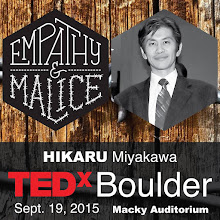
Giving presentation at TEDx Talks conference in Boulder 2015
 |
| Hikaru presenting at TEDx Talks conference in Boulder, Colorado 2015 |
My presentation at TEDx Talks conference in Boulder, Colorado was titled, "Mastery through Leonardo da Vinci."
As I have mentioned in my talk, I have been following and researching about Leonardo da Vinci ever since I "met" him through the TV show back in 1972 when I was 10 years old.
I was able to paint my rendition of Leonardo da Vinci's "Ultima Cena / The Last Supper", which took me 2,000 hours. (Not a single penny was asked.) The main section took me 1,700 hours back in 1995-1996.I am happy and thankful that it is still on the classroom wall at the Waldorf high school I used to teach.
There are many things I have "realized" through the special experience of being able to share and communicate my ideas to the large group of kind audiences via TEDxBoulder 2015 conference.
First of all, as a performer, I "LOVE" being in front of a large group of people... larger the better!' It was an ecstatic, exhilarating experience facing 2,200 people!
...and at the same time I've realized that many of the Stand-Up comedians are doing this sort of thing weekly! ...without the script (nor the band members) and with a time limit! My admiration to those brave people!
Bravo to all the entertainers, teachers, leaders, and anyone appearing before a large group of the audience!
...but with the help of the kind, patient, understanding audiences...
...and at the same time I've realized that many of the Stand-Up comedians are doing this sort of thing weekly! ...without the script (nor the band members) and with a time limit! My admiration to those brave people!
Bravo to all the entertainers, teachers, leaders, and anyone appearing before a large group of the audience!
...but with the help of the kind, patient, understanding audiences...
I also really appreciate the kind organizers and the crew members for their hard work prepping. We were in good hands.
(image credit: TED / TEDxBoulder)
(image credit: TED / TEDxBoulder)
Mastery through Leonardo da Vinci | Hikaru Miyakawa | TEDxBoulder
As another year draws to a close, I am reflecting on the exciting events which took place this year. There's one event that stands out above the rest. I was selected as one of the 12 presenters to give a presentation at TEDxBoulder 2015 conference back in September. It was a spectacular event, and I am very happy for the co presenters s well.
I'm really honored and happy to know that my presentation at TEDxBoulder 2015 was approved by official TEDx / TED organization, and it is available to be viewed via the youtube channel.
It is titled, "Master through Leonardo da Vinci."
Please enjoy! Thank you!
https://www.youtube.com/watch?v=nrHhqsMADNY
(more to follow)
Thank you TEDxBoulder and its wonderful community!
Hikaru Miyakawa
Thursday, January 22, 2015
5 Day Art Challenge on Facebook (Day 1)
Day 1 of 5 Day, 3 art per day Challenge
第一日目・1990年頃の幻想作品3点
I have been nominated by my friend, Pascal Lecocq, the artist of Blue, to participate in the 5 Day Art Challenge on Facebook, where the nominated artists are invited to share 3 pictures of their work per day for five days. It is always wonderful to be respected by the peers.
After researching, I've found that there are several ways to go about this. For me, I will show my artworks from the past which I have not yet widely shown in the cyber world and nominate at least one artist at the end of the 5 day challenge.
On this initial day, I have upload 3 works from around 1988 - 1990. These are more or less, Visionary-Fantastic works inspired by Viennese Fantastic Realism Movement.
Please enjoy!
Selection 1:
"Triumph of Hercules"
Acrylic on canvas glued to a board
©1988 Hikaru Hirata-Miyakawa (Artiste Hikaru)
private collection
Selection 2:
"Griffin turning"
Acrylic and Alkyd on masonite
© 1989 Hikaru Hirata-Miyakawa (Artiste Hikaru)
private collection
Selection 3:
"Riddle of Cerberus"
Acrylic on canvas
©1990 Hikaru Hirata-Miyakawa (Artiste Hikaru)
lost (damaged beyond repair)
第一日目・1990年頃の幻想作品3点
I have been nominated by my friend, Pascal Lecocq, the artist of Blue, to participate in the 5 Day Art Challenge on Facebook, where the nominated artists are invited to share 3 pictures of their work per day for five days. It is always wonderful to be respected by the peers.
After researching, I've found that there are several ways to go about this. For me, I will show my artworks from the past which I have not yet widely shown in the cyber world and nominate at least one artist at the end of the 5 day challenge.
On this initial day, I have upload 3 works from around 1988 - 1990. These are more or less, Visionary-Fantastic works inspired by Viennese Fantastic Realism Movement.
Please enjoy!
Selection 1:
"Triumph of Hercules"
Acrylic on canvas glued to a board
©1988 Hikaru Hirata-Miyakawa (Artiste Hikaru)
private collection
 | ||
| "Triumph of Hercules"©1988 Hikaru Hirata-Miyakawa |
"Griffin turning"
Acrylic and Alkyd on masonite
© 1989 Hikaru Hirata-Miyakawa (Artiste Hikaru)
private collection
 |
| "Griffin turning"© 1989 Hikaru Hirata-Miyakawa |
Selection 3:
"Riddle of Cerberus"
Acrylic on canvas
©1990 Hikaru Hirata-Miyakawa (Artiste Hikaru)
lost (damaged beyond repair)
 |
| "Riddle of Cerberus"©1990 Hikaru Hirata-Miyakawa |
Thursday, November 27, 2014
Happy Thanksgiving and arigato!
Happy Thanksgiving to you all!
Many of you may
already know that "thank you" in Japanese is "Arigato", and it is
written as "有難う". It comes from "有難い /arigatai ," and it roughly means
that something which hardly (or hard to) exist - existing rarely
/有る事が難しい .
It might sound paradoxical, but when you reflect on it, it
is easily understandable.
It is to do with the attitude of gratitude and
not taking anything for granted. It implies the attitude that
everything is a miracle - hard to exist/to be.
There
is a legend of Buddha relating to this. (...although the content of this legend
varies.)
One day Buddha had asked one of his disciples what he felt
about being a human. Then Buddha spoke about the story about a blind
(or one eyed) sea turtle and a log with a small hole floating / drifting
freely and randomly on the ocean. This turtle swims all the time and
comes to the surface only once in 100 years. Buddha asked his disciple
whether this blind turtle could, by chance, "happen" to stick his head
into this hole in the log when he comes to the surface or not. The
disciple basically answered that it is nearly impossible, and even if it
can happen, it would take billions and trillions of years.
Then Buddha said, "To be born as human is even harder (rarer) than that." So, he taught his disciple(s) to be grateful to be born as human (or being reborn as human after being in the low, hellish levels/states of existence.)
Then Buddha said, "To be born as human is even harder (rarer) than that." So, he taught his disciple(s) to be grateful to be born as human (or being reborn as human after being in the low, hellish levels/states of existence.)
It is true that for us to be born, even without reflecting on how many sperms must die, many thing must happen intricately.
First of all, the entire universe had to be created!!!
Thus, it is miraculous.
Feeling of unquestionable gratitude for being born as human into the vast universe is the first step towards true happiness.
...and it is our DUTY to be filled with happiness from within and emit such happiness to the surroundings and back to the universe...
Wednesday, November 19, 2014
Portrait of Isabella d'Este based on the sketch by Leonardo da Vinci
 |
| "Isabella d'Este" © 2014 by Hikaru Hirata-Miyakawa |
Acrylic on canvas
© 2014 by Hikaru Hirata-Miyakawa
Here is my rendition of the portrait of Isabella d'Este based on the sketch supposedly made by Leonardo da Vinci.
 |
| drawing by Leonardo da Vinci citation: Wikipedia |
Although some authorities claim that they have recently discovered the completed authentic Leonardo piece of the said portrait of Isabella, I disagree with such claim.
I am ultra conservative when it comes to the authentication of the works especially by Leonardo.
There seem to be a sort of an inflation of such attribution these days.
To me the final portrait has never been done by Leonardo, and since Isabella had repeatedly asked Leonardo to do her portrait, I did it in my style instead basing the composition on the drawing "done" by Leonardo. This painting of mine has nothing to do with trying to complete the painting in Leonardo's manner.
The painting of mine shown at the top is currently being displayed at eTown Hall in Boulder, Colorado.
It is part of my solo art exhibition (from November 16th, 2014 through January 31st, 2015).
Tuesday, August 12, 2014
Understanding of the tragic death of Robin Williams through Vedic astrology (jyotish)
 |
| D-1 and D-9 of Robin Williams |
The news of the death of Robin Williams has affected many fans.
I see that some of vedic astrologers have already tried to understand this tragedy through the chart analysis, etc.
Although I am not a jyotishi, I would like to bring some points as well in order to understand this mystery.
I see that some of vedic astrologers have already tried to understand this tragedy through the chart analysis, etc.
Although I am not a jyotishi, I would like to bring some points as well in order to understand this mystery.
I use Jagannatha Hora software, so if you are using other software, the calculation may be different. Since this blog is intended as a supplement for the vedic astrologers and friends, so I may skip some explanation.
I usually look at the main birth chart and D-9, the Dasha of the subject, and the transit.
I also look at the nakshatras and Yogi/Ava-Yogi points.
First, Robin was going through Ketu Mahadasha.
This incident took place in the dasha of: Ke/Me/Me/Mo/Ju
I'm including Praana-antardasa.
In Robin's natal chart, Ketu reside with Venus in Leo ruled by Sun which is Badakesha for Tula lagna, and they are in Purva Pharguni ruled by Venus, which happened to be where the Yogi point is.
By transit, Ketu has been in Meena, and it is where Jupiter(Guru) is in his natal chart which happens to be in the 12th house.
Moon is with Rahu in 11th house of Aquarius in natal chart, and at the time of his death, Moon was transiting Aquarius (Shatabhisha ruled by Rahu) as well.
By transit, Mercury, Jupiter, and Venus were with Badakesha, Sun, and Mercury was combust and near the natal Mercury position and almost sandi in Cancer. Mercury happens to be Robin's Atmakaraka (Jupiter his Amk).
3rd from natal Mercury is Sani (Saturn), and Sani is in 12th house of Virgo. I have read that Mercury can negatively affect the planets placed 3rd from it.
(i.e. Barbara Pijan-ji)
Ava Yogi point is Purva Bhadrapada, and it is ruled by Jupiter.
Jupiter is neecha in D-9.
Sani in D-9 is in Shatabhisha (ruled by Rahu) nearing the transit Moon and natal Moon.
Moon in D-9 is in Purva Bhadrapada which is near Robin's Ava Yogi point.
Badakesha Surya in D-9 is in his own house of Leo/Purva Phalguni (near Yogi point/ Natal Ketu and Venus).
The lists go on and on.
It must have been really challenging for Robin.
I hope you will join me in the prayer for Robin for the safe and healing journey after life.
Thank you,
Blessings,
Hikaru
Thursday, August 7, 2014
Reflection on the Hiroshima Day through Astro Boy - - - ( 鉄腕アトムに想う)
He
is known in the US as "Astro Boy", but his original name is "Atom (アトム)," and
as you may know, he is an atomic energy generated/powered robot created
in the image of its creator scientist Dr. Tenma's deceased child, Tobio.
Instead of spreading the hatred and fear towards the atomic energy and its creators, the author Osamu Tezuka (手塚 治虫)
created Atom to courageously face the future of mankind and still deeply care for the humanity.
"Tetsuwan Atom / 鉄腕アトム (Mighty Atom)" was written in 1952 and made its debut on Japanese TV as a cartoon show in 1963.
I along with many of the post-WW II generations grew up watching this show and listening to its opening song written by Shuntarō Tanikawa (谷川俊太郎) as a lyricist and composed by Tatsuo Takai (高井 達雄).
I always feel energized and inspired after listening to this title song.
There is the phrase in the first verse in the title song saying, "kokoro yasashi... kagaku no ko", and that is one of the phrases
I love listening while reflecting how I am and must be towards the world.
It can roughly translated as "kind hearted, child of science".
The word,"yasashii," is usually translated as"to be kind (hearted)," but it also means "to be gentle, compassionate, and caring".
It is a revolutionary thinking to imagine the robot having compassionate, caring heart.
Instead of spreading the hatred and fear towards the atomic energy and its creators, the author Osamu Tezuka (手塚 治虫)
created Atom to courageously face the future of mankind and still deeply care for the humanity.
"Tetsuwan Atom / 鉄腕アトム (Mighty Atom)" was written in 1952 and made its debut on Japanese TV as a cartoon show in 1963.
I along with many of the post-WW II generations grew up watching this show and listening to its opening song written by Shuntarō Tanikawa (谷川俊太郎) as a lyricist and composed by Tatsuo Takai (高井 達雄).
I always feel energized and inspired after listening to this title song.
There is the phrase in the first verse in the title song saying, "kokoro yasashi... kagaku no ko", and that is one of the phrases
I love listening while reflecting how I am and must be towards the world.
It can roughly translated as "kind hearted, child of science".
The word,"yasashii," is usually translated as"to be kind (hearted)," but it also means "to be gentle, compassionate, and caring".
It is a revolutionary thinking to imagine the robot having compassionate, caring heart.
Another phrase I like is at the beginning of the second verse where it says, "mimi wo sumase, me wo mihare" which roughly means
"listen intently and watch/see/observe carefully".
At first, we are lead to think that the words are meant for Atom/Astro Boy, warning him to not to get tricked into corruption
by the enemy ("yudan wo suru na"), but soon we can realize that the words are meant for all of us.
To me it goes even beyond the "warning".
It reminds me of the compassion of Kannon/Kanzeon, the Bodhisattva who "sees" the cry(sound) of the mankind".
Let us be like Atom and be progressively caring and just.
こころ優しく、こころ正しく... ね!
Sunday, June 8, 2014
How to appreciate art (paintings)...?
What is the good way, if not the best way, to appreciate art?
I 'd say, "by kneeling in front of it."
You might think, "Well, I understand the fact that each artwork is sacred, in a way, but that sounds too much like the religious devotion and not necessary appropriate for the appreciation of art, or does it???"
I agree, and what I mean by "kneeling" has a bit different connotation.
It is one of the many ways to examine how artist may have applied the paints to the given ground.
We are used to looking at the painting dead on. Certainly, we can do that. It is good to appreciate the size of the painting if it is very large instead of looking at the print reproductions or an image printed in the books. It is also good to try to study the colors of each artwork by examining the actual work.
However, we may not know the true color unless you know what kind of light (lamps) each room of the museum uses. The lights we use, for instance, can be the traditional tungsten light bulbs and/or the florescent ones. In the museums, the situation may be quite different. They know that excessive illumination can cause damages to the artworks, so some museums may not use the ordinary light bulbs. Depending on the quality of the light source, the colors may appear quite differently. You may have an experience comparing several books showing the same artwork with the different colors.
On one reproduction the color on some area may appear more orange-like, for example, and from the other reproduction the same area may appear more reddish. To help seeing the true color, one can bring a color chart, too.
The composition can be studied off the printed materials such as any post cards and/or the images reproduced in the books.
Unless one obtain a special permission from the given museum, the close examination of each artwork is not possible. If you are too close to the artwork, it will likely trigger a security alarm.
One can still learn a great deal from examining the artwork from the distance.
To study how much paints(with or without the emulsion) are applied in which
sections/areas, for example, can be done by kneeling down and looking up at the painting in a certain angle where the painted surface starts to shine by reflecting the light. If the paints are applied thickly, it will certainly reflect the light differently than the areas painted thinly and smoothly. At the same time, one can guess how much emulsion (i.e oil) is added to the paints by examining the reflection of the surface.
The image above is a section from Bronzino's work at Kunsthistorisches Museum in Vienna which I photographed during the recent visit to the museum.
I 'd say, "by kneeling in front of it."
You might think, "Well, I understand the fact that each artwork is sacred, in a way, but that sounds too much like the religious devotion and not necessary appropriate for the appreciation of art, or does it???"
I agree, and what I mean by "kneeling" has a bit different connotation.
It is one of the many ways to examine how artist may have applied the paints to the given ground.
We are used to looking at the painting dead on. Certainly, we can do that. It is good to appreciate the size of the painting if it is very large instead of looking at the print reproductions or an image printed in the books. It is also good to try to study the colors of each artwork by examining the actual work.
However, we may not know the true color unless you know what kind of light (lamps) each room of the museum uses. The lights we use, for instance, can be the traditional tungsten light bulbs and/or the florescent ones. In the museums, the situation may be quite different. They know that excessive illumination can cause damages to the artworks, so some museums may not use the ordinary light bulbs. Depending on the quality of the light source, the colors may appear quite differently. You may have an experience comparing several books showing the same artwork with the different colors.
On one reproduction the color on some area may appear more orange-like, for example, and from the other reproduction the same area may appear more reddish. To help seeing the true color, one can bring a color chart, too.
The composition can be studied off the printed materials such as any post cards and/or the images reproduced in the books.
Unless one obtain a special permission from the given museum, the close examination of each artwork is not possible. If you are too close to the artwork, it will likely trigger a security alarm.
 |
| A section from a painting by Bronzino (photo by Hikaru) |
To study how much paints(with or without the emulsion) are applied in which
sections/areas, for example, can be done by kneeling down and looking up at the painting in a certain angle where the painted surface starts to shine by reflecting the light. If the paints are applied thickly, it will certainly reflect the light differently than the areas painted thinly and smoothly. At the same time, one can guess how much emulsion (i.e oil) is added to the paints by examining the reflection of the surface.
The image above is a section from Bronzino's work at Kunsthistorisches Museum in Vienna which I photographed during the recent visit to the museum.
Tuesday, February 11, 2014
My new website: Portraits by Hikaru
Well, I've managed to launch a new website of mine exclusively dealing
with doing the Portrait related painting commissions.
with doing the Portrait related painting commissions.
Since I've been doing this type of art commissions, it was necessary to
create the new site.
Some of the visitors of my older (but main) site have expressed that
they were confused about what I do.
create the new site.
Some of the visitors of my older (but main) site have expressed that
they were confused about what I do.
...and that's fair enough... because I do many things.
Besides, I have enough works to show in the new website independent
from my main one.
from my main one.
So, I hope you will enjoy visiting my new site, and perhaps giving me the
portrait/pet portrait/memorial portrait painting commissions.
portrait/pet portrait/memorial portrait painting commissions.
 |
| A sample page from the website, "Portraits by Hikaru" |
I can immortalize your dear ones!
Please feel free to visit the site! Portrait by Hikaru
Thank you!
Wednesday, January 8, 2014
 |
| Hikaru's rendition of a painting, "St John the Baptist" by Leonardo da Vinci |
Toward the end of his life, Leonardo decides to return to the Florentine motif of using the festaiuolo. According to Michael Baxandall, a festaiuolo is a choric figure who introduce the play and remained on the stage while the paly is going on acting as a mediator who may point to what is essential and/or central on the stage. ("Painting and Experience in Fifteenth-Century Italy" Oxford University Press, 1972, p71-73 )
Usually, the choric, angelic festaiuolo is pointing towards something and /or someone which clearly exists; however, we are not certain of what this being is pointing towards. Is it the Heaven? Dark void?
We also do not know the identity of this being.
He appears androgynous. Man and a woman in one. ...an original Adam before the separation/creation of Eve? Or is he an Angel?
Generally, this painting is known as Saint John the Baptist, but the cross and the animal skin, according to some of the experts, seem to be added later. If we mentally strip these "extra" elements, we are left with the few clues to the identity of this being.
A festaiuolo can be an angel or a human, so he can be St. John the Baptist.
We know that Christian tradition equates St. John the Baptist as Elijah like forerunner of Christ. By quoting the Old Testament (Tanakh), the New Testament Gospels equates St. John as the messenger who is sent before Christ/Moshiah(Messiah).
It is interesting to know that the word for an "angel" in either Hebrew ( מלאך ), Aramaic ( ܡܠܐܟܐ ), or Greek ( αγγελον )also has a meaning, a "messenger".
The being in this painting seems to be pointing towards the point of origin. Is it the Garden of Eden where we may have fallen?
Or, one can see it as where we were born/created (a womb like place)
.. and perhaps the place we do return after death.
Perhaps this is a youthful angel of death imagined by Leonardo to take him to the world after life. It was towards the end of his life when he began painting this image and supposedly have brought it over the Alps to France.
This being is putting his left hand on his heart as if to swear that he is there to show Leonardo the way back(?)without deception and to take him on his last adventure/journey 'home.' This youthful being with the gentle gesture and a bit mischievous smile may be the combination of his beloved Melzi, and Salai. It may also be that this being is Leonardo himself in his youth, since the being is placing his "left" hand on his chest, not just showing the gesture to swear, but to remind us that it is "he," Leonardo, who had painted and created this picture, an inner self, who is the reflection of "Imago Dei"... {The painting at the top of this blog is my rendition of Leonardo's "Saint John the Baptist," and I have titled it as "Angelos" (angel/messenger) © Hikaru Hirata - Miyakawa}
Thursday, January 2, 2014
Throwback Thursday - Society Magazin article
Happy New Year to you all!
May this year bring you much joy and prosperity!
Today, I'd like to share something from the past as "Throwback Thursday."
Back in 2011,I was featured in the issue 357 of the Society Magazin in Austria.
The magazine is related to United Nation and embraced by the heads of the government/state, the diplomats, and the powerful members of the high society in Austria and beyond, so I, as an artist in Boulder, Colorado, am very honored to be introduced into such circle of people.
It briefly mentions about my interest in the life and the works by Leonardo da Vinci.
In fact the index on page 6 introduces the article with the title, "Universalkünstler Hikaru (Universal Artist Hikaru)" !
The magazine is published in two forms, physical and online, so I would love to inform you the direct link to the site. It is from the page 106 to 108.

May this year bring you much joy and prosperity!
Today, I'd like to share something from the past as "Throwback Thursday."
Back in 2011,I was featured in the issue 357 of the Society Magazin in Austria.
The magazine is related to United Nation and embraced by the heads of the government/state, the diplomats, and the powerful members of the high society in Austria and beyond, so I, as an artist in Boulder, Colorado, am very honored to be introduced into such circle of people.
It briefly mentions about my interest in the life and the works by Leonardo da Vinci.
In fact the index on page 6 introduces the article with the title, "Universalkünstler Hikaru (Universal Artist Hikaru)" !
The magazine is published in two forms, physical and online, so I would love to inform you the direct link to the site. It is from the page 106 to 108.
It is also wonderful to be next to the article about the music festival directed by Ricardo Muti, an accomplished Symphony conductor!
The articles are usually written in German, but they have kindly written about me in English.
Please feel free to visit the site and read the online article!

Thank you Society Magazin!
オーストリア国の、外交官、有力者、ハイ・ソサエティー のメンバーの方々の間ではお馴染みの、Society Magazinの357号誌に私に関する記事が紹介されております。 オンラインでもご覧頂けるので、もしよろしければ、お読み下さい。 普通は、ドイツ 語主体で書かれておりますが、今回は、態々英語で紹介して頂いております。
オーストリア国の、外交官、有力者、ハイ・ソサエティー のメンバーの方々の間ではお馴染みの、Society Magazinの357号誌に私に関する記事が紹介されております。 オンラインでもご覧頂けるので、もしよろしければ、お読み下さい。 普通は、ドイツ 語主体で書かれておりますが、今回は、態々英語で紹介して頂いております。
海外に住む日本人として、大変有難いことと思います。
Tuesday, July 2, 2013
Why I love accepting the art commissions
I love accepting the art (painting and drawing) commissions, for I am able to know the mind of the client
and realize his/her idea on this material world. ...making ideas (non-thing) of others
into the tangible reality (thing).
At a time, I have gladly accepted the "Memorial Portrait" (portraiture) paintings and drawings because I can imbue the artwork with the feeling of "immortality" to the person who had crossed the threshold, and sometimes it brings the healing to the loved ones.
If you have not done this, you are missing out on the wonderful feeling full of satisfaction!
into the tangible reality (thing).
At a time, I have gladly accepted the "Memorial Portrait" (portraiture) paintings and drawings because I can imbue the artwork with the feeling of "immortality" to the person who had crossed the threshold, and sometimes it brings the healing to the loved ones.
If you have not done this, you are missing out on the wonderful feeling full of satisfaction!
 |
| "Remembering Celeste" - a "memorial portrait" painting in acrylic by Hikaru Hirata-Miyakawa |
and use my skills (originally given as the gift from the divine) for the good for the
others.
others.
Letting go of my ego and letting go of my "style" is the "practice".
I sometimes prefer these commissioned works to my own creations.
The need of my ego to express myself yields to the needs of the others.
The need of my ego to express myself yields to the needs of the others.
After all, all the great masters of the Italian Renaissance I admire had served the
needs of the others, their Patrons.
Although not in the same magnitude, I am able to experience minute aspects of what
needs of the others, their Patrons.
Although not in the same magnitude, I am able to experience minute aspects of what
those creators may have gone through... their struggles and the feeling of
satisfaction...
satisfaction...
It is the privilege to be entrusted of such importance - someone's vision.
The work is manifested out of the tight team work and the deep trust in each other.
Being given such art commission in-itself is an honor.
 |
| Mural art commission sample by artist Hikaru in Boulder |
Having said that, it does not mean it is always easy and cheerful, and I am not
talking about the skill required. That's a given!
talking about the skill required. That's a given!
The difficulty arise when the one who commissions and the one who accepts have the
different ideas. In order to complete the birthing of artworks, neither party can exercise
ego-inflation. Neither party can bulldoze the other away. It is the exercise in diplomacy.
The great works of art, the timeless art almost always have served the need of the "other"
humans (humanity) and/or created for the greater good.
It is birthed through the struggle of the creator (painter, sculptor, etc) within trying to balance
the need of his/her ego on one hand and the need of the humanity (and beyond - universe)
on the other.
Whenever I see the smile out of satisfaction on the clients' and patrons' faces after they see
the completed works, I feel joy within, and I am also deeply satisfied.
...and that's my job... and I'm just doing my job.
Tuesday, January 1, 2013

Happy New Year to you all!
I hope this year, 2013, would bring joy and prosperity to you and your dear ones.
Thank you very much for your warm support throughout 2012.
For me, the year 2012 was a transformational year especially regarding my artistic direction. I have literally gone through the "death and rebirth" process intensely especially
since last June, so I have decided to share my process with you.
Since the beginning of the year 2012, I was aware of the process of metamorphosis within me.
At the same time, I was realizing that I have reached the top of one mountain, so to speak.
 |
| "Dancing Ganesha" |
Although I could have keep going the way I was going with many sketched almost ready to be materialized, I felt the need for the change in the statusquo. This could mean the end of my Mannerist expression, but some how I felt it was necessary to "graduate" being Pontormo of the 20th/21st century and get on with my life. By the way, Pontormo was under the wing of my beloved master, Leonardo da Vinci! Of course, I had no intention of stopping mycareer as an artist, so I went on the soul quest - the quest for the new expression. Consequently, "Dancing Ganesha" became the last of the Mannerist series.
First thing I did was to move away from my habitual creative process and began experimenting with the abstract way of expressing myself. It was not a brand new experience, for I have painted abstractly before. I also tried other forms of expression.
Soon I realized the voice telling me what to do, and it was rather a "rigid",inflexible, dogmatic voice. This voice was not an intuitive one. It was a habitual one. It was telling me what I "should" do instead of what I "could" do. For example, my voice would tell me to strictly stick with the non-recognizable form (even when I see the potential to bring out the familiar forms) since I am doing an abstract painting. To listen to this voice had meant that I had to become less (or least) spontaneous and/or playful in my creative process. Since one of my reasons for going through with this informational journey is to free myself from self inflicting dogma, I allowed the recognizable form to come out. (By saying this, I do not imply that I have not been playful in the past. No, I have been.)
Within two months, I came to the symbolic threshold. To cross it was like crossing the Rubicon river. Entering the competition sponsored by WPA to do with the QR Code was such crossing to me since one of the agreements the artists had to make in order to participate in this exhibition was to agree to let the artwork being defaced/destroyed.
 |
| for the WPA exhibition |
I agreed with it feeling that this would be my symbolic crossing of the threshold. It was interesting to know that my work was accepted right away. The acceptance message came earlier than the designated date! I took this as the big sign of "OK" from the Universe and God.
 |
| "Tohu wa Bohu" |
Destruction can be followed by creation.
I went through the "Tohu-wa-Bohu" stage. Then one day, one of my dear friends who saw one of my experimental paintings said something, and it has acted like the "Let there be light (enlightenment)!" call out.
 |
| "Ryu-gu Castle" |
After that moment, the separation of upper and lower water event happened.
I knew that the heaven/firmament in Hebrew, Ha-Sh-Mayim, contains the word,Mayim (water/sea). Mary the Mother, whom I have painted many times with sort of a devotion, has the name meaning "bitter sea" (Maryam). I recalled the near drowning experience in the sea followed by self rescuing effort. I realized my late-father's name means "illuminating (illumination of) the sea/ocean". I also have worked as a chef at the sushi restaurants...etc., etc., etc. ... all of these events and experiences led to me to the theme: sea/ocean!
It was like putting the dormant and missing pieces of puzzle together, and itoccurred during the Year of Water Dragon and followed by the year 2013 as the year of Water Snake!
I also have heard that there are more people on the moon than the people who had explored the deeper part of the ocean. I felt the need to bring the awareness of the people to the ocean, our mother and her creatures.
 |
| "Whale" |
In the year 2011, Japan had suffered the disaster - earthquake followed by Tsunami and the failure of nuclear power plant causing the radioactive pollution.
It is most appropriate for me as Japanese artist to pray for the safety of my people and for the safe journey of the departed souls through my artistic activities. It is as if I am appeasing the Japanese sea god, Wadatsumi.
 |
| "Wadatsumi" |
I also have added the new dimension (from exclusively 2D creations to more 3D creations) to my artistic activities using the paper (tree derived) products both new and the recycled.
These creations will soon be revealed when it is ready.
The solo exhibition which opened in the beginning part of December is going well. I am hearing many complements so far and am thankful.
I know that my informational journey is continuing, but for now, I am continuing painting with the sea/ocean as the theme, and I KNOW in my heart and soul that I am no the right path.
All the artworks above: © 2012 by Hikaru Hirata-Miyakawa
All rights reserved.
Subscribe to:
Posts (Atom)